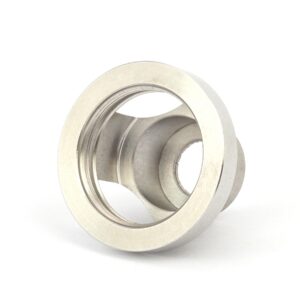
Chrome plating, also known as chromium plating, is an electroplating process that involves applying a thin layer of chromium onto a metal or plastic object. The result is a surface that is highly valued for its aesthetic appeal, hardness, and corrosion resistance.
There are two primary types of chrome plating:
Decorative Chrome (Nickel-Chrome): A thin, bright, and shiny coating used for appearance and mild corrosion resistance.
Hard Chrome (Industrial Chrome): A much thicker coating used for engineering purposes, such as reducing wear and friction, and restoring dimensions to worn parts.
The Electroplating Process: A Step-by-Step Breakdown
The process is complex and requires meticulous preparation to ensure adhesion and quality.
Step 1: Pre-Treatment (The Most Critical Phase)
This phase prepares the substrate (the base material) to receive the chromium layer.
Cleaning: The part is thoroughly cleaned to remove all dirt, oil, and grease. This is typically done using alkaline cleaners and ultrasonic baths.
Rinsing: Multiple rinses in deionized water remove any residual cleaning solutions.
Surface Activation: The part is dipped in an acid bath to remove light oxides and microscopically etch the surface. This ensures a strong mechanical bond. For materials like stainless steel or nickel, a reverse-current etch in the plating bath itself is often used.
Step 2: The Plating Bath
The cleaned and activated part is immersed in an electrolytic bath (plating tank).
The Bath Composition: The bath contains a solution of chromic acid (CrO₃) and a catalyst, most commonly sulfuric acid (H₂SO₄). This mixture creates hexavalent chromium ions, which are the source of the chromium metal. Modern trivalent chromium processes are also gaining popularity due to their lower environmental and health impact.
The Setup: The part to be plated is connected to the negative terminal of a DC power supply, making it the cathode. Bars of lead or lead-tin alloy are connected to the positive terminal, acting as the anodes.
Step 3: The Electroplating Reaction
When the electrical current is applied, a electrochemical reduction reaction occurs.
Chromium ions (Cr⁶⁺) in the solution are attracted to the negatively charged cathode (the part).
At the cathode’s surface, these ions gain electrons and are reduced to metallic chromium (Cr⁰), which bonds atom by atom to the surface of the part.
Hydrogen gas (H₂) is a byproduct of this reaction, which can be seen as bubbles rising from the part.
Step 4: Post-Treatment
After the desired thickness is achieved, the part is removed from the bath.
Rinsing: It is thoroughly rinsed to remove all plating solution.
Drying: The part is dried quickly to prevent water spots.
Baking: For high-strength steel parts, baking is essential to relieve hydrogen embrittlement—a condition where hydrogen atoms diffuse into the metal, making it brittle and prone to cracking.
Key Properties and Characteristics of Chrome Plating
High Hardness: Chrome plating is extremely hard, typically ranging between 68-72 on the Rockwell C scale. This makes it highly resistant to abrasion and wear.
Low Coefficient of Friction: Chrome has a naturally slippery surface, making it ideal for applications requiring reduced friction (e.g., hydraulic piston rods).
Corrosion Resistance: The chrome layer provides excellent resistance to tarnish, rust, and corrosion from various chemicals and environmental conditions.
Aesthetic Appeal: It provides a brilliant, mirror-like, blue-white finish that is highly reflective and easy to clean.
Adhesion: When applied correctly, the chrome layer forms a very strong bond with the underlying material.
Types of Chrome Plating
- Decorative Chrome Plating
Purpose: Primarily for appearance.
Process: It is almost always plated over an underlying layer of nickel (and sometimes copper). The nickel provides the true corrosion resistance and lustrous brightness, while the very thin chrome layer (0.00001 to 0.00004 inches) is applied on top to prevent the nickel from tarnishing and to provide a slight blue tint.
Applications: Automotive trim, wheels, bathroom fixtures, kitchen appliances, furniture, and consumer goods.
- Hard Chrome Plating
Purpose: For engineering and functional performance.
Process: The chromium is plated directly onto the base metal (usually steel) without an intermediate nickel layer. The coating is much thicker, typically ranging from 0.0005 to 0.005 inches, or even thicker for rebuilding worn parts.
Applications: Hydraulic piston rods, industrial rollers, mold surfaces, gun bores, cutting tools, and aircraft landing gear components.
Environmental and Health Considerations
Traditional chrome plating using Hexavalent Chromium (Cr⁶⁺) poses significant challenges:
Toxicity: Cr⁶⁺ is a known human carcinogen when inhaled and is highly toxic.
Environmental Hazard: The waste products are dangerous and require careful, costly disposal.
Regulations: It is heavily regulated worldwide (e.g., by REACH and OSHA).
The Alternative: Trivalent Chromium (Cr³⁺) Plating
Safer: Cr³⁺ is significantly less toxic and is not classified as a carcinogen.
Environmental Benefits: Waste treatment is simpler and more cost-effective.
Performance: While historically not as hard or corrosion-resistant as hexavalent chrome, modern trivalent processes have improved dramatically. It is now widely used for decorative applications and is often the preferred choice for new installations due to regulatory pressures.
Common Defects and Challenges
Poor Adhesion: Caused by inadequate cleaning or activation, leading to peeling or flaking.
Burning: A rough, dark deposit caused by too high a current density.
Cloudy or Dull Finish: Often due to contamination in the bath or improper bath chemistry.
Hydrogen Embrittlement: A serious issue for high-strength steel parts, requiring post-plate baking to mitigate.
Cracking: Chromium deposits have a micro-cracked pattern, which is normal. However, excessive cracking can be a problem.
Summary Table: Decorative vs. Hard Chrome
| Feature | Decorative Chrome | Hard Chrome |
| Primary Purpose | Aesthetics, mild corrosion resistance | Wear resistance, reduce friction, rebuild parts |
| Thickness | Very thin (0.00001″ – 0.00004″) | Thick (0.0005″ – 0.005″+) |
| Underlayer | Copper and Nickel | Directly on base metal |
| Appearance | Bright, mirror-like, blue-white | Duller, greyish-metallic, can be ground/polished |
| Hardness | Hard, but the underlying nickel is softer | Extremely hard (68-72 HRC) |
| Common Uses | Auto trim, faucets, wheels | Piston rods, industrial machinery, molds |
In conclusion, chrome plating is a versatile but technically demanding process that transforms the surface properties of a component. While facing environmental challenges, it remains a critical technology for both creating beautiful, durable finishes and solving demanding industrial engineering problems.