Although every alloy has a typical shrinkage range, the actual casting shrinkage of alloys is influenced by much more than material selection alone. Even when using the same alloy, shrinkage behavior can vary depending on production conditions, casting design, and process parameters. Understanding these factors allows foundries to better predict shrinkage and manufacture castings with improved dimensional accuracy and consistency.
Alloy Composition
The chemical composition of an alloy is one of the most significant factors affecting casting shrinkage of alloys. Different alloying elements influence melting temperature, solidification behavior, and thermal expansion, resulting in different shrinkage characteristics.
For example, stainless steels generally exhibit higher shrinkage than gray cast iron, while aluminum alloys typically experience lower shrinkage than carbon steels. Even small variations in alloy composition can lead to measurable differences in shrinkage behavior.
Casting Geometry
The shape and complexity of a casting also influence how the alloy shrinks during cooling. Components with irregular geometries, large cross-sections, or isolated heavy areas tend to cool unevenly, which can result in localized shrinkage.
Designing castings with balanced geometry helps promote more uniform solidification throughout the component.
Wall Thickness
Wall thickness has a direct effect on cooling speed. Thin sections cool rapidly, while thicker sections retain heat for a longer period. When a casting contains large variations in wall thickness, different areas cool at different rates, increasing the likelihood of uneven contraction.
Maintaining relatively uniform wall thickness is a common engineering practice for improving dimensional stability.
Mold Material
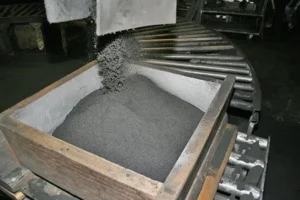
Different mold materials remove heat from molten metal at different rates. Sand molds cool more slowly than ceramic or metal molds, affecting the solidification process and the final casting shrinkage of alloys.
The selection of mold material is therefore an important consideration when establishing appropriate shrinkage allowances.
Pouring Temperature
Molten metal must be poured within an appropriate temperature range. If the pouring temperature is too high, the alloy contains additional heat energy and requires more time to cool, which may increase overall shrinkage.
Conversely, pouring at excessively low temperatures may affect mold filling and casting quality. Maintaining proper pouring temperatures helps improve both dimensional accuracy and production consistency.
Cooling Rate
The rate at which a casting cools significantly affects its final dimensions. Rapid cooling and slow cooling produce different solidification characteristics, leading to variations in the casting shrinkage of alloys.
Controlling cooling conditions throughout the production process helps foundries achieve more predictable shrinkage behavior.
Feeding System Design
The gating and feeding system plays an essential role in compensating for volume reduction during solidification. Properly designed runners, gates, and risers ensure that molten metal continues to feed the casting as shrinkage occurs.
An optimized feeding system helps maintain casting integrity and contributes to consistent dimensional accuracy.
Pattern Shrinkage Allowance
Before production begins, foundries incorporate a shrinkage allowance into the pattern design based on the expected casting shrinkage of alloys. The pattern is intentionally made larger than the desired finished casting so that the final dimensions match the engineering drawing after cooling.
Accurate shrinkage allowances are determined through a combination of material data, engineering calculations, and production experience.
Manufacturing Experience
Although industry reference values provide a useful starting point, experienced foundries understand that actual casting shrinkage of alloys often requires practical adjustments. Production history, process optimization, equipment capabilities, and engineering expertise all contribute to more accurate shrinkage prediction.
By combining theoretical calculations with real manufacturing experience, foundries can achieve higher dimensional consistency, reduce production variation, and improve the overall quality of finished castings.