In the journey from raw material to finished component, one critical stage often determines whether a part merely meets specifications or truly excels in application: surface finishing. This final frontier of manufacturing encompasses the treatments, coatings, and processes that transform a machined or cast surface into something far more capable—resistant to corrosion, optimized for wear, enhanced in appearance, or prepared for assembly. At Juize Machinery, our expertise extends deep into this essential discipline. As a Gold Verified Supplier on Alibaba, we understand that how a component’s surface is finished is often as important as how it is shaped.
Why Surface Finishing Matters
The surface of a component is its interface with the world—the boundary where it encounters environment, engages with mating parts, and expresses its quality. Surface finishing serves multiple critical functions:
Corrosion Protection: Preventing oxidation and chemical attack that would otherwise degrade the component over time.
Wear Resistance: Extending service life by hardening surfaces against friction and abrasion.
Aesthetic Enhancement: Creating visual appeal through color, texture, and uniformity.
Functional Properties: Modifying electrical conductivity, lubricity, or biocompatibility.
Surface Preparation: Creating optimal conditions for painting, bonding, or subsequent assembly.
Neglecting surface finishing can undermine even the most precisely manufactured component, leading to premature failure, poor appearance, or assembly difficulties. Conversely, thoughtful finishing extends life, enhances performance, and elevates perceived quality.
Mechanical Surface Treatments: Preparing the Foundation
Before applying coatings or treatments, components often require mechanical surface preparation. These processes establish the foundation upon which subsequent finishing builds.
Blasting and Abrasive Cleaning
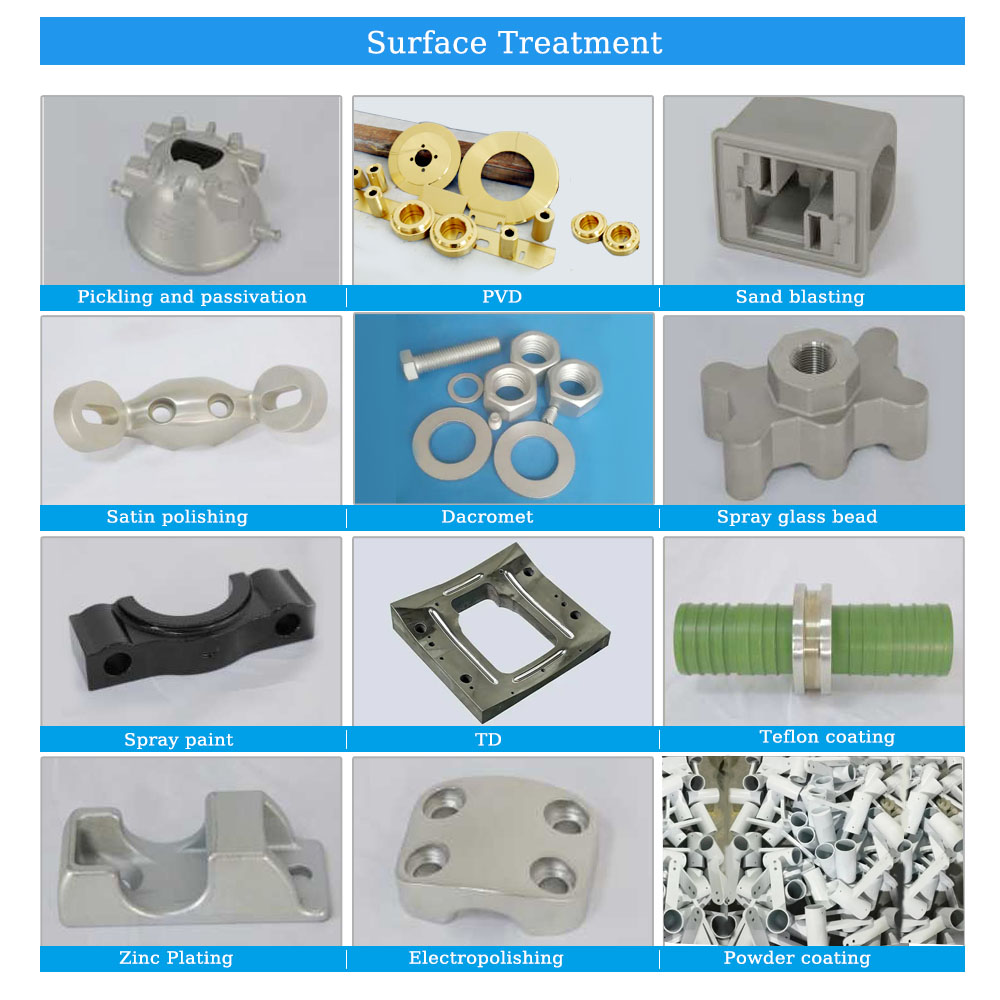
Media blasting propels abrasive particles against the component surface, cleaning away scale, rust, and contaminants while creating a uniform texture. Steel shot creates a peened surface that improves fatigue resistance. Glass bead produces a satin finish without dimensional change. Aluminum oxide cuts aggressively for heavy cleaning. Each media type serves specific purposes, and our selection depends on the base material and intended final finish.
Grinding and Polishing
For surfaces requiring specific smoothness or reflectivity, grinding and polishing progressively refine the surface. Coarse abrasives remove material and correct geometry; finer grits reduce surface roughness; polishing compounds create mirror finishes. Applications range from sealing surfaces requiring flatness to decorative components demanding visual perfection.
Deburring and Edge Breaking
Every machining operation leaves microscopic burrs—raised edges that can interfere with assembly, cause injury during handling, or become stress concentration points. Our deburring processes, whether manual, tumbling, or specialized machines, ensure all edges are cleanly finished, often with controlled radii specified by your drawings.
Chemical and Electrochemical Treatments
These processes modify the surface through chemical reactions, enhancing properties without adding significant thickness.
Passivation of Stainless Steel
Stainless steel’s corrosion resistance depends on a thin, transparent oxide layer that forms naturally but can be compromised by surface contamination from machining. Passivation uses controlled acid solutions to remove free iron and other surface contaminants, allowing the protective oxide layer to reform uniformly. This treatment is essential for medical devices, food processing equipment, and any application where corrosion resistance is critical.
Black Oxide
Black oxide coatings convert the surface of ferrous metals into magnetite, a stable black oxide layer that provides mild corrosion resistance, reduces light reflection, and improves appearance. The process also creates a surface that retains lubricating oils, beneficial for moving components. Black oxide adds negligible dimensional change, making it suitable for precision parts where tolerances cannot accommodate coating thickness.
Electropolishing
The reverse of electroplating, electropolishing removes a thin layer of material through electrochemical means. The process preferentially dissolves microscopic peaks, creating an exceptionally smooth, bright surface with enhanced corrosion resistance. Electropolishing also passivates stainless steel simultaneously, making it ideal for sanitary applications, semiconductor components, and parts requiring maximum cleanability.
Plating and Coating Technologies
These processes apply distinct layers to the component surface, adding thickness and introducing new material properties.
Zinc Plating
One of the most common and cost-effective corrosion protection methods, zinc plating applies a thin zinc layer to ferrous components. The zinc serves as a sacrificial coating—corroding preferentially to protect the underlying steel. Clear, yellow, or black passivation treatments can be applied over the zinc for enhanced protection and distinctive appearance. Applications span automotive fasteners, brackets, and hardware of all kinds.
Nickel Plating
Electroless nickel plating deposits a uniform nickel-phosphorus alloy layer without requiring electrical current. The process coats complex shapes evenly, including internal surfaces and blind holes. The resulting surface offers excellent corrosion resistance, hardness, and lubricity. Applications include hydraulic components, valves, and parts exposed to corrosive environments.
Chrome Plating
Hard chrome plating deposits thick chromium layers for exceptional wear resistance and low friction. The process is commonly applied to hydraulic rods, cylinder bores, and components subject to abrasive wear. Decorative chrome, applied over nickel, provides the bright, tarnish-resistant finish familiar on consumer products.
Powder Coating
Dry powder coating has largely replaced liquid painting for many applications due to its durability, environmental friendliness, and aesthetic versatility. Electrostatically charged powder particles adhere to the grounded component, then flow and fuse in a curing oven, creating a uniform, tough finish. Available in countless colors and textures—smooth, textured, metallic, matte, gloss—powder coating protects against corrosion, impact, and weathering. Applications range from heavy equipment enclosures to consumer goods requiring attractive, durable finishes.
Anodizing: The Aluminum Specialist
Anodizing deserves special attention as the premier finishing process for aluminum components. Through electrolytic oxidation, anodizing converts the aluminum surface into a thick, controlled aluminum oxide layer—integral to the base material rather than applied over it.
Type I (Chromic Acid Anodizing) produces thin, corrosion-resistant layers ideal for aerospace applications and components requiring minimal dimensional change.
Type II (Sulfuric Acid Anodizing) creates thicker, harder layers that can be dyed in virtually any color. This is the most common anodizing specification, serving applications from consumer electronics to architectural components.
Type III (Hard Anodizing) generates exceptionally thick, dense oxide layers with hardness approaching that of sapphire. Hard anodized surfaces resist extreme wear and corrosion, serving demanding applications in military, industrial, and automotive environments.
Anodized surfaces offer outstanding corrosion protection, excellent paint adhesion, electrical insulation, and decorative possibilities through dyeing. The coating is integral to the aluminum, so it cannot peel or flake—a significant advantage over applied coatings.
Heat Treatment: Transforming Properties from Within
While not strictly a surface treatment, heat treatment often complements finishing by modifying material properties throughout the component—or selectively at the surface.
Through Hardening heats the entire component to austenitizing temperature, then quenches rapidly to achieve uniform hardness throughout. The process requires tempering afterward to relieve brittleness while retaining desired hardness.
Case Hardening selectively hardens the surface while maintaining a tough, ductile core. Carburizing introduces carbon into the surface layer at high temperature, followed by quenching. Nitriding introduces nitrogen at lower temperatures, creating extremely hard surfaces without quenching and minimal distortion. Induction hardening uses electromagnetic fields to heat specific surface areas rapidly, followed by immediate quenching.
These treatments produce components with wear-resistant surfaces and impact-resistant cores—ideal for gears, shafts, and bearings.
Painting and Liquid Coatings
Despite advances in powder coating, liquid painting remains essential for many applications. Modern industrial paints offer sophisticated formulations:
Primers provide adhesion and corrosion protection.
Topcoats deliver color, gloss, and environmental resistance.
Clear coats protect underlying finishes while adding depth.
Specialty coatings offer unique properties—high-temperature resistance, chemical resistance, electrical conductivity, or anti-graffiti characteristics.
Application methods range from conventional spray to electrostatic, from dip coating to brush. Our selection depends on component geometry, production volume, and performance requirements.
Assembly-Level Finishing Considerations
When components progress to sub-assemblies, finishing considerations evolve. Masking protects critical surfaces—sealing faces, threaded holes, electrical contact points—from coating processes. Selective plating applies precious metals only where needed. Post-coating assembly may require careful handling to preserve finishes.
Our integrated approach ensures finishing decisions consider not just individual components, but their interaction in final assemblies. A coating that protects perfectly but interferes with adhesive bonding serves no one. We evaluate the complete picture.
Quality Verification in Finishing
Surface finishes demand rigorous verification. Our quality systems include:
Thickness Measurement: X-ray fluorescence, magnetic induction, and eddy current instruments verify coating thickness meets specifications.
Adhesion Testing: Cross-hatch tape tests, pull-off tests, and impact tests ensure coatings bond properly.
Corrosion Testing: Salt spray chambers simulate years of environmental exposure in days, validating protection levels.
Hardness Testing: Microhardness measurement confirms heat treatment and hard coating effectiveness.
Visual Inspection: Trained inspectors evaluate appearance, color, and surface uniformity under controlled lighting.
Partnering for Optimal Finishing
Surface finishing decisions involve trade-offs—performance versus cost, appearance versus durability, process compatibility versus ideal properties. Our engineering team guides you through these considerations, recommending finishing strategies that optimize your component for its specific application.
Whether your parts require the extreme wear resistance of hard chrome, the corrosion protection of zinc plating, the decorative appeal of powder coating, or the integral durability of anodizing, we possess the expertise and capabilities to deliver.
Exploring finishing options for your next project?
Let our surface finishing specialists guide you toward the optimal solution. Contact us to discuss your requirements and discover how thoughtful finishing can elevate your components from good to exceptional.